
Oct 16, 2026
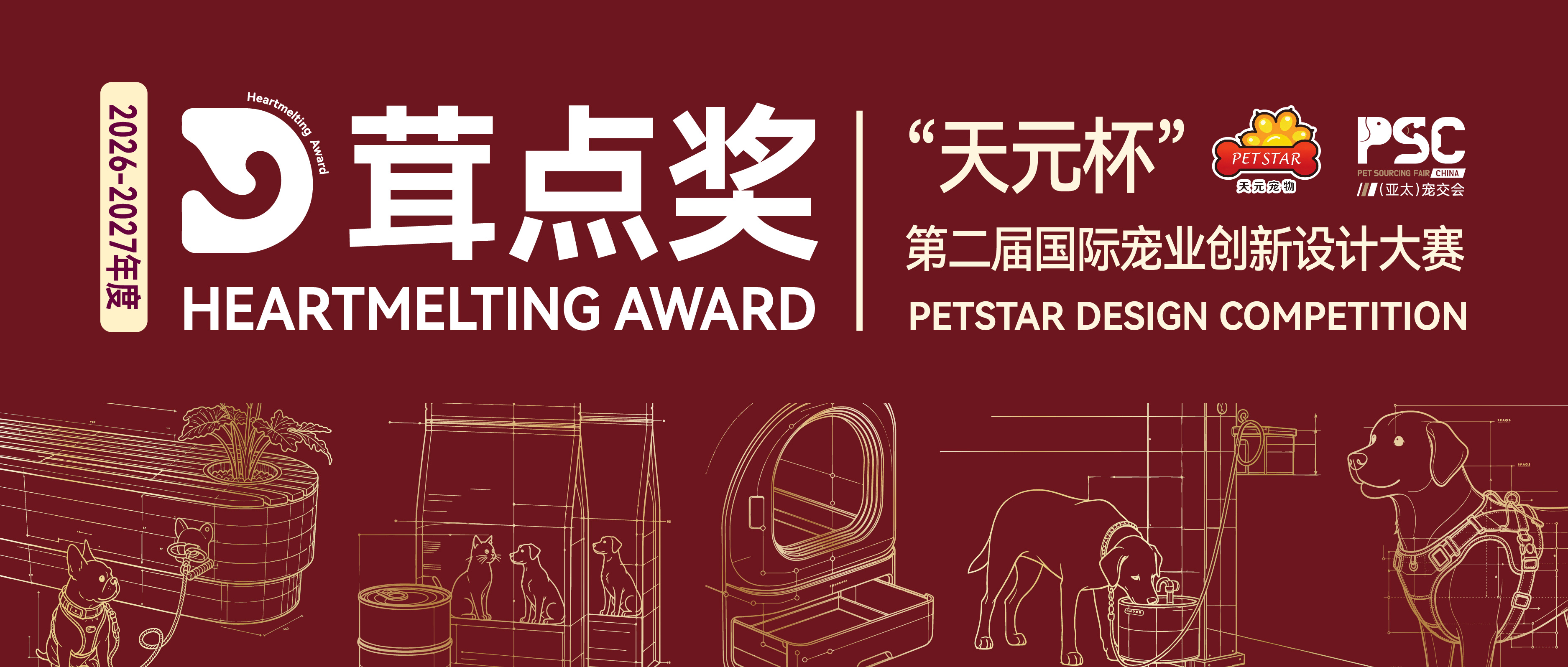
The competition promotes the idea of people and pets living in harmony and advancing green, sustainable development. It aims to help the pet products industry move from meeting functional needs toward designing better relationships, while identifying talented designers and outstanding works with market potential and supporting the commercialization of innovative results.
Organizer:
Naming Partner:
Special Supporters:
Co-organizers:
Special Partners:
The competition is open to entries submitted by companies, organizations or individuals. Eligible participants include domestic and international professional design firms, spatial designers, manufacturers, independent designers, higher education institutions and their students or faculty, and product design enthusiasts.
Product/Space Design Group: Open to domestic and international companies, organizations, design studios, educational institutions and individuals.
Concept Design Group: Open to full-time students, including students in junior colleges, higher vocational colleges, undergraduate and postgraduate programs, and doctoral programs.
Participants may enter as a company, team or individual. There is no limit on the number of works submitted overall, but each participant may submit no more than five works.
Participants may submit works under any of the following themes.
“A shared home for our furry companions” captures the reality of life in a multi-pet household. Traditional pet products are often designed for a single pet: one cat bed, one food bowl, one litter box, each treated as a separate item. In a multi-pet home, however, space is limited, resources must be shared, territories need to be defined, and relationships require careful coordination. Just as a shared apartment needs a balance between communal areas and private rooms, a multi-pet household must find the right balance between sharing and independence.
Sharing a home is about more than reallocating physical space; it calls for a new understanding of relationships among pets and between people and pets. When twelve cats with different temperaments live together, “home” is no longer simply a matter of aesthetics and function. It becomes an ongoing practice of coordination, adjustment and cohabitation. The greatest challenge in a multi-pet household is not only cleaning, but also managing relationships. Product design must therefore move beyond the logic of “one product for one pet” toward an ecosystem in which a coordinated set of products serves a group of pets.
This is not a story about overcrowding, but one about coexistence. The ultimate value of home ecosystem design lies not in making more products, but in building better relationships: harmony among pets, closer bonds between people and pets, and comfortable coexistence for all living beings in the same space. Design becomes a carrier of emotion and relationships.
We invite participants to respond with close observation, systems thinking and human-centered care, and to offer their answers to the shared-home era—so that every bond of companionship has a place to call home.
Traveling with ease is a state of mind for pet owners and a state of comfort for pets. This theme focuses on practical challenges when traveling with pets: scattered equipment, inconvenient access, stress in unfamiliar situations and difficult transitions between settings. Using an integrated travel bag as the design platform, participants are invited to organize seven basic needs—eating, drinking, toileting, sleeping, play and protection—into modular storage, enabling smooth transitions from packing and carrying to car travel and hotel stays.
“Mobile shelter” means that the bag is more than a container; it can serve as a temporary safe space for a pet during a journey. Details such as adjustable ventilation, flexible dividers and familiar scent retention can help pets feel at home in unfamiliar surroundings. The carrying system and access flow should also be optimized so that one person can manage a short outing or a multi-day trip with ease.
Lower the psychological barrier to traveling with pets, so that more moments of companionship are not left behind because of cumbersome equipment. Make a journey a shared memory for people and pets, rather than a burden.
As pets shift from being “luggage left in storage” to welcome guests, the underlying logic of commercial spaces is changing. Pet shops are becoming more than rows of shelves and cages; veterinary clinics are moving beyond purely functional white walls and stainless steel; and pet cafés are becoming more than places that simply “allow dogs.” The deeper change is that spaces must respond to two kinds of users, each with different physical needs, behavior and expectations. People need efficiency, social connection and enjoyment; pets need safety, opportunities to explore and boundaries where they can retreat.
A commercial space shared by people and pets is fundamentally a design challenge about boundaries. There should be perceptible, but not necessarily rigid, separation between pet activity areas and human circulation routes. Retail displays and experience routes should invite pets to participate rather than exclude them. Hygiene and odor management should be built into decisions about materials, flooring, ventilation and cleaning routes, rather than handled only after problems arise. Every product in a commercial space—from retail pet products to boarding units, grooming stations and interactive installations—is part of the overall spatial experience. How a product is seen, touched and used within the space is itself a design question.
Participants are encouraged to approach the theme from both “products within spaces” and “spaces made up of products.” Choose a specific type of commercial setting—such as a pet retail store, veterinary clinic, pet park, pet-friendly café, hotel pet floor or community pet-service hub—and propose a systematic solution that balances business needs, animal welfare and human warmth. The design may address the space itself, a product system integrated into the space, or both.
Commercial spaces are real-world testing grounds for relationships between people and pets. Design must respond to practical constraints such as visitor flow, space utilization, cleaning costs, animal stress, customer complaints and operational efficiency. The ultimate value of “sharing the same space” is not making a place look pet-friendly, but ensuring that it works day after day: pets feel safe, owners feel comfortable, staff are not overburdened, and the business can operate sustainably. Design fulfills its purpose when a commercial space can accommodate different users—not by eliminating differences, but by allowing them to coexist harmoniously.
Suggested title: “An Open Theme: Writing the Next Chapter of Everyday Life with Pets.” Participants may create their own subtitle based on their understanding of the pet industry.
An open theme is not a blank page; it is an invitation to ask an open-ended question. It does not prescribe a type of pet, spatial setting, product category or technology. Instead, it gives participants the freedom to define the design brief. Starting from real observations, participants are encouraged to formulate a specific, focused and thoughtful question. It may address dignity across a pet’s life—from early socialization and adult behavior to senior care and end-of-life farewells; shared urban, community, commercial or public spaces; ethical issues involving stray animals, exotic pets, adoption or rescue; or topics such as smart companionship, sustainable materials, hygiene systems, emotional well-being and coordination among multiple pets. Freedom does not mean a lack of direction. It means looking beyond established product categories and returning to the fundamentals of life, relationships, settings and systems.
The open theme encourages design to return from category conventions to real-life needs. Designers are invited to become keen observers and problem setters before becoming problem solvers—not simply to create one more product for pets, but to offer another possibility for people and pets to live together. It gives visibility to overlooked needs and design form to relationships that have not yet been named, helping the pet industry move from the “pet economy” toward a culture of coexistence. May every bond of companionship have a place, and every question lead to a more comfortable, warmer and more sustainable way of living together.
This competition primarily solicits works in pet home and entertainment products, smart pet products, pet travel products, pet food packaging and pet-related spatial design.
Entries must comply with national industrial policies and applicable technical requirements and standards. They should reflect low-carbon, green and environmentally responsible design, with meaningful innovation in areas such as function, structure, technology, form, materials, processes, energy efficiency or environmental performance. Participants may create works based on any of the themes. In principle, entries must be original works completed before October 2026, with all intellectual property rights held by the entrant.
Product/Space Design Group
Entries must be products or design proposals that have been launched or built within the past two years; are not yet on the market but can enter mass production within two years; or are not yet built but can be completed and put into use within three months. Entries must comply with national industrial policies.
Concept Design Group
Entries must be original designs or proposals that have not been sold or manufactured on the market and have not been physically built or implemented. They should demonstrate significant innovation in function, structure, form, technology, materials or low-carbon design.
To ensure a fair competition, the presentation boards must not display the author’s name, affiliated organization, initials in English or pinyin, or any icon, graphic or other information that could reveal the author’s identity. Entries that fail to comply will be considered invalid and disqualified.
| Stage | Date |
|---|---|
| Preliminary registration | September 27–December 11, 2026 |
| Preliminary judging | December 12–20, 2026 |
| Advancement notifications | December 21–31, 2026 |
| Final | February 23, 2027 |
| Awards ceremony | February 23, 2027 |
Product/Space Design Group
Material innovation (10 points)
Technology integration (8 points)
Material utilization (7 points)
Human–pet interaction (10 points)
Safety and durability (8 points)
Scenario suitability (7 points)
Manufacturing feasibility (8 points)
Finished-product quality (7 points)
Quality inspection and compliance (5 points)
Environmental performance across the life cycle (8 points)
Communication of green principles (7 points)
Cost control and value for money (7 points)
Emotional connection with users (5 points)
Commercialization potential (3 points)
Concept Design Group
Industry leadership (10 points)
Depth of technology integration (8 points)
Social innovation (7 points)
Future interaction design (10 points)
Ethics and safety (7 points)
Inclusive design (3 points)
Closed-loop system (10 points)
Resource regeneration (7 points)
Communication of principles (3 points)
Future manufacturing technologies (6 points)
Cost control (4 points)
Anticipation of consumption scenarios (6 points)
Cultural resonance (4 points)
Entries will be evaluated under the competition rules, and finalists will be selected based on the overall results of the preliminary review. If scores are tied, ranking will be used to determine advancement.
Product/Space Design Group
| Award | Home & Entertainment | Smart Products | Travel |
|---|---|---|---|
| Grand Prize | 1 award · RMB 10,000 | 1 award · RMB 10,000 | 1 award · RMB 10,000 |
| Gold Award | 3 awards · RMB 1,000 each | 3 awards · RMB 1,000 each | 3 awards · RMB 1,000 each |
| Merit Award | Several · RMB 100 each | Several · RMB 100 each | Several · RMB 100 each |
| Award | Packaging | Spatial Design |
|---|---|---|
| Grand Prize | 1 award · RMB 10,000 | 1 award · RMB 10,000 |
| Gold Award | 3 awards · RMB 1,000 each | 3 awards · RMB 1,000 each |
| Merit Award | Several · RMB 100 each | Several · RMB 100 each |
Concept Design Group
| Award | Home & Entertainment | Smart Products | Travel |
|---|---|---|---|
| Grand Prize | 1 award · RMB 1,000 | 1 award · RMB 1,000 | 1 award · RMB 1,000 |
| Merit Award | Several · RMB 100 each | Several · RMB 100 each | Several · RMB 100 each |
| Award | Packaging | Spatial Design |
|---|---|---|
| Grand Prize | 1 award · RMB 1,000 | 1 award · RMB 1,000 |
| Merit Award | Several · RMB 100 each | Several · RMB 100 each |
Award recipients are responsible for paying individual income tax. To maintain award quality, the organizing committee reserves the right to withhold or reduce certain awards.
The total prize pool is RMB 100,000. Approximately 100 participants are expected to advance to the final.
Authors of works selected for the final review who attend in person will receive electronic proof of ownership for their design work free of charge.
The organizing committee will issue Outstanding Organization Award certificates to organizations and Outstanding Individual certificates to individuals that make significant contributions to organizing, promoting or judging the competition. Instructors who fulfill their professional guidance responsibilities with distinction will receive Outstanding Instructor certificates.
The competition works with media outlets inside and outside the industry to provide coverage throughout the event, explore the works and the stories behind them, and increase the public visibility of outstanding design.
For award-winning proposals or products with commercialization potential, the organizing committee may arrange introductions between participants and pet-product manufacturers to support the commercialization of design outcomes.
For concept design entries, the organizing committee will arrange production of presentation boards. Oversized works will be reproduced at a proportionally reduced scale.
Finalists must attend the on-site competition; otherwise, they will be treated as having voluntarily withdrawn from judging. Award recipients will be invited to the awards ceremony and related events.
Entry fee: There is no entry fee for this competition.
Entry form: Scan the QR code below to download the entry form.
Registration email: pibcgla@126.com
Enquiries: Ms. Chen, +86 185 1109 9338; Ms. Cui, +86 135 0123 7784
Scan the QR code to download the entry form.
The organizers reserve the right of final interpretation of these rules and related competition matters. For matters not covered here or questions about the rules, participants may contact the organizers using the official contact details published for the competition. The organizers will respond promptly and may supplement or revise the rules where necessary.