
Sep 03, 2026
A long‑term rise in disposable income helps explain why spending on pets, pet food and related services has steadily climbed.可支配收入的长期增长有助于解释为什么在宠物、宠物食品和相关服务上的支出稳步攀升。

Personal spending on pets, pet products and related services in the United States has grown consistently for nearly a century, showing resilience through periods of economic downturn, like the Great Recession and pandemic. According to U.S. Bureau of Economic Analysis data published by the Federal Reserve Bank of St. Louis, inflation-adjusted personal consumption expenditures in this category have expanded from near zero in the early 1930s to more than US$180 billion by 2023.近一个世纪以来,美国人在宠物、宠物产品和相关服务上的个人支出一直在持续增长,在经济衰退和大流行等经济低迷时期表现出了韧性。根据圣路易斯联邦储备银行公布的美国经济分析局数据,经通胀调整后,这类个人消费支出已从20世纪30年代初的几乎为零,扩大到2023年的1800多亿美元。
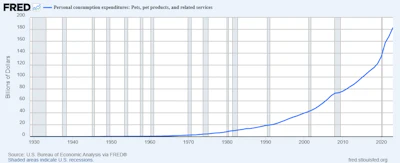
U.S. Bureau of Economic Analysis data published by the Federal Reserve Bank of St. Louis
美国经济分析局数据由圣路易斯联邦储备银行公布
The chart above illustrates a near-continuous upward trajectory in pet-related spending from 1930 to the present. Despite periodic U.S. recessions, marked on the chart in gray, consumer expenditures in the pet sector experienced only temporary slowdowns, rarely plateauing and never declining significantly.上面的图表说明了从1930年到现在,宠物相关支出几乎连续上升的轨迹。尽管美国有周期性的经济衰退,但宠物行业的消费者支出只经历了暂时的放缓,很少停滞不前,也从未大幅下降。
Throughout the 20th century, pet-related expenditures increased modestly, particularly from the 1960s through the 1980s. This gradual rise paralleled gains in household disposable income, suburbanization and a cultural shift toward viewing pets as family members. The pace of growth accelerated in the 1990s and early 2000s, likely supported by economic expansion and increased dual-income households, which provided more discretionary spending capacity.在整个20世纪,与宠物有关的支出适度增长,特别是从20世纪60年代到80年代。这种逐渐上升的趋势与家庭可支配收入的增长、郊区化以及将宠物视为家庭成员的文化转变相一致。在20世纪90年代和21世纪初,增长速度加快,可能是受到经济扩张和双收入家庭增加的支持,这提供了更多的可自由支配的支出能力。
The 2001 and 2008 recessions caused some deceleration in spending growth but did not result in contractions. After the 2008 financial crisis, spending on pets continued to grow, reflecting the sector's defensive nature. Industry analysts often attribute this resilience to the emotional bond between owners and pets, which tends to translate into non-discretionary spending habits.2001年和2008年的经济衰退导致支出增长有所减速,但并未导致经济收缩。2008年金融危机后,宠物支出持续增长,反映出该行业的防御性。行业分析师通常将这种弹性归因于主人和宠物之间的情感纽带,这种情感纽带往往会转化为非自由支配的消费习惯。
Post-2010, spending sharply accelerated. From 2010 to 2023, personal consumption expenditures in the pet category more than doubled. This period coincided with both rising household wealth and increased pet ownership rates. The COVID-19 pandemic further fueled this growth, as millions of Americans adopted pets and invested in their care during lockdowns.2010年后,支出急剧加速。从2010年到2023年,宠物类的个人消费支出增加了一倍多。这一时期恰逢家庭财富增长和宠物拥有率上升。COVID-19大流行进一步推动了这一增长,因为数百万美国人在封锁期间收养了宠物并投资照顾它们。
The correlation between disposable income and pet expenditures indicates that as U.S. households gained economic ground, their spending on pet food, veterinary services, grooming and other pet products followed suit. While economic uncertainty can impact some discretionary categories, pet-related spending has shown itself to be more stable, making the sector a reliable growth area within consumer goods.可支配收入与宠物支出之间的相关性表明,随着美国家庭经济增长,他们在宠物食品、兽医服务、美容和其他宠物产品上的支出也随之增加。虽然经济的不确定性可能会影响一些可自由支配的品类,但与宠物相关的支出显示出更为稳定,使该行业成为消费品中可靠的增长领域。
The Fed’s Real Disposable Personal Income: Per Capita (in chained 2017 dollars) data reflects the income households have available after taxes, adjusted for inflation. In 1939, real disposable income per capita was about US$7,946. By contrast, by August 2025 that measure had reached roughly US$52,830. This represents a more than six‑fold increase in real disposable income per person over roughly 85 years.美联储的实际可支配个人收入:人均(以2017年美元计算)数据反映了经通胀调整后的家庭税后可用收入。1939年,人均实际可支配收入约为7,946美元。相比之下,到2025年8月,这一指标已达到约52,830美元。这意味着在大约85年的时间里,人均实际可支配收入增长了6倍多。
That long‑term rise in disposable income helps explain why spending on pets, pet food and related services has steadily climbed. The increase in per‑person disposable income, rather than simply pet food price inflation or pet population growth, points to real growth in consumers’ discretionary budgets for pet food and similar products.可支配收入的长期增长有助于解释为什么在宠物、宠物食品和相关服务上的支出稳步攀升。人均可支配收入的增长,而不仅仅是宠物食品价格的上涨或宠物数量的增长,表明了消费者在宠物食品和类似产品上的可自由支配预算的实际增长。