
Aug 19, 2026
As pet ownership continues to increase, the pet care industry grows along with it. However, the exponential increases and lofty growth predictions year after year have slowed as economic pressures have trickled down to impact the industry. Prognosticators have replaced their ambitious predictions for upcoming years with more conservative estimates when it comes to sales growth and industry market size.
“Globally, pet food consumption and sales continue to grow, but the pace has moderated in recent years,” said Sahiba Puri, senior consultant at London-based market research provider Euromonitor International. “Volumes across price segments have faced headwinds due to elevated prices and shifting pet demographics.”
Source: American Pet Products Association and Euromonitor International *2025 estimated year-end sales
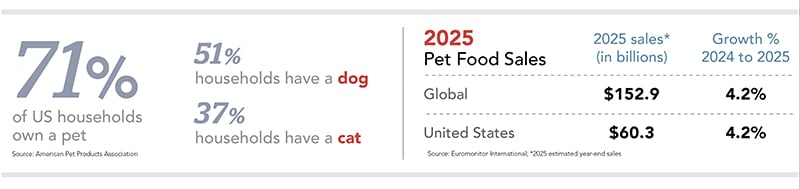
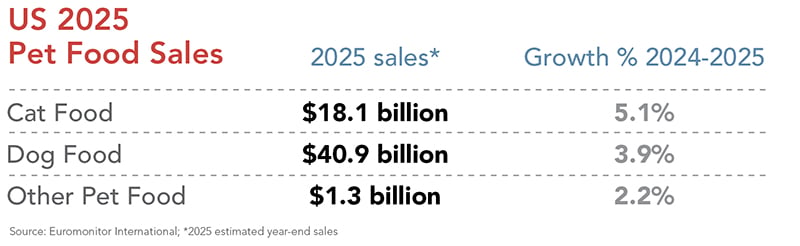
Euromonitor predicts global pet food sales will reach $152.9 billion in 2025, a 4.2% increase from $146.7 billion in 2024. The United States is set to achieve $60.39 billion in pet food sales, an increase of 4.2% from $57.9 billion in 2024. In 2025, dog food sales in the United States are predicted to increase 3.9% to $40.9 billion and cat food sales will increase 5.1% to $18.1 billion, according to Euromonitor.
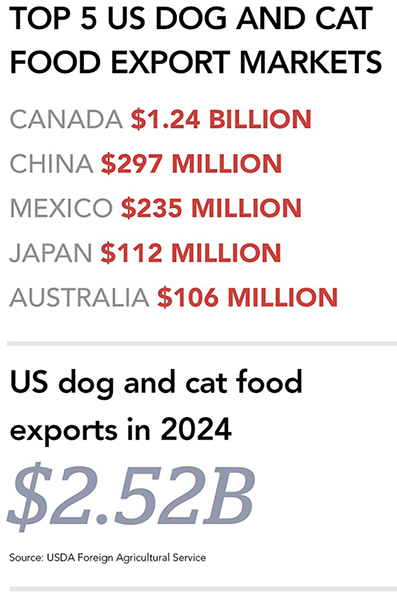
US dog and cat food exports reached $2.52 billion in 2024, according to the USDA Foreign Agricultural Service, with the top five export markets being Canada ($1.24 billion), China ($297 million), Mexico ($235 million), Japan ($112 million) and Australia ($106 million).
According to the American Pet Products Association (APPA), and its State of the Industry Report, total industry sales reached $152 billion in 2024, a 3.4% increase from $147 billion in 2023. This increase was slightly lower than the 7.4% increase that occurred between 2022 and 2023.
● $65.8 billion was spent on pet food and treats (a 2.8% increase from 2023, following a 10.8% increase between 2022 and 2023)
● $39.8 billion was spent on veterinary care and product sales (a 3.9% increase over 2023)
● $33.3 billion was spent on pet supplies, live animals and OTC medication (a 4.1% increase from 2023)
● $13 billion was spent on other services, including grooming, dog walking and boarding (a 5.7% increase over 2023)
Source: USDA Foreign Agricultural Service
Additionally, the pet industry provided an economic contribution of $312 billion in 2024, a 3% increase from $303 billion in 2023. And 2.8 million US jobs were directly or indirectly tied to pet-related expenditures, with an associated $144.2 billion in personal earnings.
For 2025, APPA projects industry sales will total $157 billion, with pet food and treats reaching $67.8 billion; vet care and product sales increasing to $41.4 billion; supplies, live animals and OTC medicines reaching $34.3 billion; and other services increasing to $13.5 billion.
While sales for the pet industry are expected to continue to grow through the end of the decade, predictions have lowered. In the APPA’s 2023 State of the Industry report, the association forecasted sales would reach $250 billion by 2030. However, in the 2025 report, APPA took a more conservative approach with a projection that industry sales will only grow to $192 billion by 2030.
Category growth
According to Chicago-based market research firm Circana, the sales of many of the pet food categories, especially those on the dog side, decreased between August 2024 and August 2025. Circana’s multi-outlet data includes sales across grocery, drug, mass market, convenience, military, pet specialty and select club, dollar, beauty and online retailers.
Source: Euromonitor International *2025 estimated year-end sales
On the dog side, there were decreases in sales in dry, wet, semi-moist and freeze-dried categories. In the 52 weeks ended Aug. 10, 2025, Circana reported dry dog food sales decreased 2.9% from the year prior to $14.2 billion. Nestlé Purina, private label brands and Mars Petcare were the top three dry dog food manufacturers over the past year.
Wet dog food sales decreased 3.6% to $3.9 billion, with Mars Petcare, Nestlé Purina and private label brands leading the way. Semi-moist dog food sales decreased 9.2% to $118 million, led by Nestlé Purina, Mars Petcare and Because It’s Better. Freeze-dried dog food sales decreased 0.1% to $304 billion, with Stella & Chewy’s, Nature’s Variety and Merrick Petcare leading the way.
The refrigerated/frozen dog food category was the only one that increased from the year prior, growing 17.8% to $1.6 billion. Freshpet, JustFoodForDogs and Nature’s Variety were the top three refrigerated/frozen dog food manufacturers leading sales over the past year.
Sales increased almost across the board on the cat side between August 2024 and the 52 weeks following. Dry cat food increased 3.3% to $5.5 billion with Nestlé Purina, Big Heart Pet Brands and Mars Petcare leading the way. Wet cat food increased 6.2% to $5.9 billion, led by Nestlé Purina, private label brands and Mars Petcare. Refrigerated/frozen cat food increased 0.8% to $27.7 million, with Freshpet, Primal Pet Foods and Vital Essentials leading the sales.
Semi-moist cat food was the only category that decreased between 2024 and 2025, falling 10% to $14 million. Hartz Mountain Corporation, Inaba Foods and Hill’s Pet Nutrition were the top three semi-moist cat food manufacturers leading sales over the past year.
The treat category saw increases compared to the year prior on both the cat and dog side. The dog treat category experienced a slight 1.2% increase to $6.8 billion with Big Heart Pet Brands, private label brands and Mars Petcare leading the category. On the cat treat side, Mars Petcare, Hartz Mountain and Nestlé Purina were the top three cat treat manufacturers leading the overall sales, which increased 11.4% to $2 billion between August 2024 and August 2025.
Pet ownership
While there appears to be a slowdown in pet industry sales, pet ownership remains strong. According to APPA’s State of the Industry report, 71% of US households, around 94 million, owned a pet in 2024. Fifty-one percent (about 68 million) of US households own dogs and 37% (about 49 million) of US households own cats. In addition, 63% of US households own multiple pets.
“Pet care remains a top priority for Americans, reflecting the deep and lasting bond between people and their pets, especially with the Millennials and Gen Zs who are more likely to have multiple pets than their Boomer and Gen X counterparts,” said Pete Scott of the American Pet Products Association
“The pet industry continues to demonstrate resilience, even amid economic uncertainty. What’s encouraging is that pet ownership itself is expanding, with 94 million US households now owning at least one pet,” shared Pete Scott, president and chief executive officer of the APPA. “These figures reaffirm that pet care remains a top priority for Americans, reflecting the deep and lasting bond between people and their pets, especially with the Millennials and Gen Zs who are more likely to have multiple pets than their Boomer and Gen X counterparts.”
Millennials lead the way in pet ownership, accounting for 30%, followed by Boomers and Gen Xers with 25% each. At this point, Gen Zers still represent the smallest cohort of pet owners at 20%, however this demographic has experienced the largest increase in ownership year-over-year.
“Gen Z is coming in a big way, so we need to be paying attention and we need to be responding accordingly,” said Ingrid Chu, vice president of research insights at APPA, during the organization’s presentation on the report during Global Pet Expo. “And, if this is going to be an indicator of what the future is going to look like, Gen Z is also more likely to have more than one pet in the household.”
● Millennials account for 32% of dog owners and 32% of cat owners
● Gen Xers make up 25% of dog owners and 24% of cat owners
● Boomers account for 22% of dog owners and 23% of cat owners
● Gen Zers make up 20% of dog owners and 20% of cat owners
The APPA’s “2025 Dog and Cat Report,” released in June, showed a rise in pet ownership by younger cohorts, as well as a rise in cat ownership overall.
“Our latest Dog & Cat Report confirms what many in the industry have sensed — pet ownership continues to evolve in meaningful ways, with dogs and cats more integrated into our lives than ever before,” Scott said. “From prioritizing pet nutrition to the rise of multi-cat households, today’s pet owners are redefining what it means to care for a companion animal. These insights reflect not only the powerful bond between humans and their pets, but a roadmap for where the pet industry is headed next.”
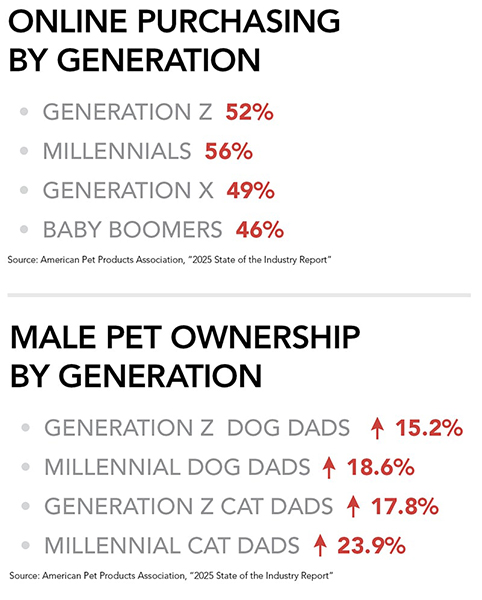
Pet ownership among younger males, both Gen Zers and Millennials, also appears to be on the rise. Fifty-eight percent of Gen Z males and 63% of Millennial males owned a dog in 2024. Thirty-eight percent of Gen Z males and 46% of Millennial males owned a cat in 2024.
“The rise of the ‘cat dad,’ particularly among Gen Z and Millennial men, is a standout trend,” Chu explained during a briefing following the release of the report. “There has been nearly a 20% increase in Gen Z cat dads and almost a 25% in Millennial cat dads last year. So, the outdated stereotype of being a cat owner is definitely evolving.”
In addition, households with two cats increased by 8% and households with three or more cats increased by 36% since 2018, according to the report.
“This shift toward multiple cat ownership represents an opportunity for pet food manufacturers to capture larger household spending per customer,” Chu added.
With humanization still at the forefront of the pet industry, pet owners continue to look for ways to strengthen the bond with their four-legged family members. APPA’s report showed that the percentage of cat owners hosting holiday or birthday parties for their cats is 21%, increasing immensely by 250% from 2018. There was also a significant increase of 89% in the number of cat owners who purchased pet-themed merchandise since 2018.
The humanization trend is thriving on the dog side as well, with 53% of owners reporting they bring their pup along on foot for daily errands or activities at least once a week, which is a 6% increase from 2023. Eighty-seven percent also reported traveling by car with their dogs and 74% reported taking at least one plane trip with their dog.
Online vs. in-store
The battle for dollar share continues between brick-and-mortar and online retailers when it comes to pet food and treat purchases. While online sales have been on the rise for years, the 2020 pandemic was a turning point at which point in-store sales started to decline as those online started to consistently rise.
Source: Euromonitor International *2025 estimated year-end sales
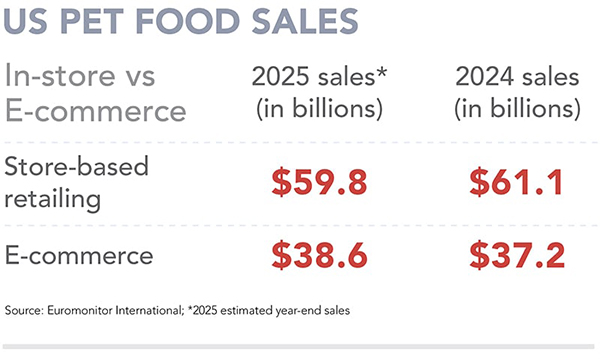
According to Euromonitor, in-store pet food sales decreased 14.2% between 2020 and 2025 from $69.7 billion to $59.8 billion. While on the e-commerce side, sales have increased 45.7% between 2020 and 2025 from $26.5 billion to $38.6 billion.
“Grocery retail infrastructures across most markets have not evolved to cater to a wider assortment and portfolio of pet food. While some retailers are investing in upgrading the pet food aisle, this phenomenon remains limited,” Puri said. “On the other hand, pet ownership is becoming more nuanced, with a growing desire for specialized products. In this regard, beyond factors like convenience, online sales are being driven by an expanding digitally native consumer base, particularly of Millennials and Gen Z pet owners.”
APPA’s report showed 51% of all pet parents purchased pet products online and 47% purchased them in-store in 2024. Overall, 40% of pet parents reported increasing the number of online purchases in 2024, 50% reported this stayed the same and only 10% reported a decrease.
As expected, younger pet owners are more likely to shop online than older pet owners.
● 56% of Millennials shop online versus 42% in-store (a 4% increase from 2023)
● 52% of Gen Zers shop online versus 45% in-store
● 49% of Gen Xers shop online versus 48% in-store
● 46% of Boomers shop online versus 52% in-store
“E-commerce also remains the preferred launch pad for new brands looking to bring innovative formats and offerings to the market,” Puri added.
Source: American Pet Products Association, “2025 State of the Industry Report”
However, most pet parents aren’t choosing one method to shop for their pet, instead most are using an omnichannel approach — purchasing both in-store and online.
“We’ve heard a lot about e-commerce, and we’ve heard a lot about brick-and-mortar, as in the ‘death of brick-and-mortar,’” Chu said during her research presentation during Global Pet Expo. “It’s actually not the death of brick-and-mortar, it’s the evolution and we call it omnichannel.”
As the industry continues to see more online purchases, subscription-based purchasing has also increased. According to APPA, 52% of all pet parents in 2024 reported using subscription-based purchasing — 31% of shoppers used this method to purchase pet food, 19% for pet treats, and 16% for pet vitamins and supplements.
Again, the younger generations are more likely to purchase subscription-based pet care items with 61% of Gen Zers, 59% of Millennials, 47% of Gen Xers and 39% of Boomers.
Focus on functional
The focus on pet wellness is seen throughout the industry from the increase in health-specific, tailored diets to the rise in functional pet treats to the ongoing growth on the supplement side.
APPA’s Dog and Cat report found that 53% of dog owners give their canines vitamins or supplements — a 6% increase from 2023 and a 56% increase from 2018. Thirty-four percent of cat owners give their felines vitamins or supplements — a 6% increase from 2023 and a 70% increase from 2018.
According to Circana, sales of dog supplements grew 9.2% to $633 million, with Nutramax Labs, Nestlé Purina and PetIQ leading the category. Sales of cat supplements grew 27.9% to $53.1 million with Nestlé Purina, Nutramax Labs and Pet Honesty leading the category.
“As pet owners want their pets to live a long and healthy life, without increasing vet visits, they are adopting a preventative approach to managing their pet’s health,” Puri said. “While pet dietary supplements have directly benefited from this, the non-therapeutic pet food space is also adopting a health-centric approach. Attributes like functional benefits and health claims are being deployed to communicate expected benefits from consumption. There is a growing focus on specialized needs, personalized care and science-forward formulations.”

